Tuesday, 26 April 2016
OUIL401- Studio Brief 2- Visual Response Pamphlet Proposed Images
Here are the proposed designs for the pamphlet I was aiming to create to coincide with my realised images.

OUIL401- Studio Brief 2- Realised Visual Responses
There is very very little information freely available about this subject, with most of it kept close to the 'experts' chests, maybe to not give the opposition an advantage. I wanted to illustrate the 5 main theories of retail anthropology and how they work so I began by making images based directly off the theories to give as clear an idea as to what they are as possible.

The first image was meant to represent the 'power wall' theory, an idea that suggests that the first wall on the right as you enter the store should be merchandised with best sellers, high ticket items, and seasonal items, as this is the first thing the customer will notice upon entering the store.

My next image was made to illustrate the 'decompression zone' theory, which explains that anything within 5-15ft of the door (depending on store size) will usually be disregarded by the customers until they enter 'shopping mode' so there is no real point having any product before that point.

My next image is of the 'merchandise outpost', which is where small collections of merchandise are kept at key points of the store, such as till points and at the ends of isles to encourage impulse buys.

My fourth image is to illustrate the 'speed bumps' theory, the theory that by placing small samples of product on a point of sale in between larger selling spaces, it will slow the customer down so to encourage them to spend more time in the store and therefore more time spent browsing/ buying.

My final image is to represent the 'eye level- buy level' theory, which simply suggests that more notice will be taken of product placed on eye level, so high ticket and high sellers should be placed here.
Overall I am fairly happy with how the images have turned out, given time, I may place the images into a small leaflet or pamphlet with some information so to give them a bit more background.
I will look at continually developing through my visual journal to investigate any further avenues.
OUIL401- Studio Brief 2- Useful Links/ Quotes
http://www.cracked.com/article_18805_5-ways-stores-use-science-to-trick-you-into-buying-crap.html
'We know that rotational patterns like this are common in herd animals, like elephants, but nobody is quite sure why humans do it. Studies have shown that British, Australian or Japanese shoppers tend to go the opposite way (clockwise) through the store, so some have speculated that it's based on the side of the road you're most used to driving on. If you drive on the right, you head right and follow the wall around.'
Companies employ psychological theory to influence where we move and where to put key product.
(https://www.shopify.co.uk/blog/13955461-visual-merchandising-101-how-to-create-store-designs-with-high-converting-displays)
'There are an endless array of visual cues you can play around with to communicate your message. From using colors for their psychological triggers, to leveraging lighting, symmetry, balance, contrast, and focus to direct and control where a customer looks and for how long, it's one of the most fascinating components of merchandising.'
Playing around with different colours and balances of visual elements can influence customers where to look.http://newsfeed.time.com/2011/01/27/how-ikea-seduces-its-customers-by-trapping-them/'Using a strategy employed by out-of-town retail parks – “trapping” the customers in store for as long as they can – IKEA places as many distractions as possible between the customer and the item they may have come for. The path is “effectively their catalog in physical form” says Penn. “You’re directed through their marketplace area where a staggering amount of purchases are impulse buys, things like light bulbs or a cheap casserole that you weren’t planning on getting … Because the layout is so confusing you know you won’t be able to go back and get it later, so you pop it in your [cart] as you go past.”'
Most retail companies employ techniques to keep the customer 'trapped' in the store, "the more time people spend in the store, the more likely they are to buy more".
"Several empirical studies of store environments (Groeppel-Klein 2001; Groeppel-Klein and Germelmann 2003; Grossbart and Rammohan 1981; Sommer and Aitkens 1982) show evidence of a significant correlation between the existence of mental maps of stores (knowledge of product location, assortment, service points in malls, escalators, etc.) and consumers’ feelings about how convenient the shopping experience is. Furthermore, Reimers and Clulow (2004) find a significant relationship between mental search costs and 5 the perceived convenience of retail spaces: the more detailed the mental map, the less mental effort needed when searching for products."
Counter-clockwise or clockwise? The impact of the store layout on the process of orienting in a discount store
People use a store in which they are used to using one, through mental maps of other stores?
http://www.fastmoving.co.za/newsletters/retail-126/store-layout-responds-to-consumer-shopping-habits-95
'We know that rotational patterns like this are common in herd animals, like elephants, but nobody is quite sure why humans do it. Studies have shown that British, Australian or Japanese shoppers tend to go the opposite way (clockwise) through the store, so some have speculated that it's based on the side of the road you're most used to driving on. If you drive on the right, you head right and follow the wall around.'
Companies employ psychological theory to influence where we move and where to put key product.
(https://www.shopify.co.uk/blog/13955461-visual-merchandising-101-how-to-create-store-designs-with-high-converting-displays)
'There are an endless array of visual cues you can play around with to communicate your message. From using colors for their psychological triggers, to leveraging lighting, symmetry, balance, contrast, and focus to direct and control where a customer looks and for how long, it's one of the most fascinating components of merchandising.'
Playing around with different colours and balances of visual elements can influence customers where to look.http://newsfeed.time.com/2011/01/27/how-ikea-seduces-its-customers-by-trapping-them/'Using a strategy employed by out-of-town retail parks – “trapping” the customers in store for as long as they can – IKEA places as many distractions as possible between the customer and the item they may have come for. The path is “effectively their catalog in physical form” says Penn. “You’re directed through their marketplace area where a staggering amount of purchases are impulse buys, things like light bulbs or a cheap casserole that you weren’t planning on getting … Because the layout is so confusing you know you won’t be able to go back and get it later, so you pop it in your [cart] as you go past.”'
Most retail companies employ techniques to keep the customer 'trapped' in the store, "the more time people spend in the store, the more likely they are to buy more".
"Several empirical studies of store environments (Groeppel-Klein 2001; Groeppel-Klein and Germelmann 2003; Grossbart and Rammohan 1981; Sommer and Aitkens 1982) show evidence of a significant correlation between the existence of mental maps of stores (knowledge of product location, assortment, service points in malls, escalators, etc.) and consumers’ feelings about how convenient the shopping experience is. Furthermore, Reimers and Clulow (2004) find a significant relationship between mental search costs and 5 the perceived convenience of retail spaces: the more detailed the mental map, the less mental effort needed when searching for products."
Counter-clockwise or clockwise? The impact of the store layout on the process of orienting in a discount store
People use a store in which they are used to using one, through mental maps of other stores?
http://www.fastmoving.co.za/newsletters/retail-126/store-layout-responds-to-consumer-shopping-habits-95
OUIL401- Studio Brief 2- Fundamental Retail Layout
Through my research, I have started to narrow down ideas of retail layout and the psychology behind it.
Below are what I think to be the key ideas and most appropriate for most businesses.
The Decompression Zone
The Decompression Zone is the space that’s located just inside your front door. The size of your DZ will depend upon the size of your sales floor, but it’s generally the first 5’ to 15’ inside the front door. Its purpose is to give shoppers a chance to transition from whatever happened in the parking lot, to your store -- it refocuses the customer on shopping. Your DZ needs to be open, inviting and easy to navigate. Understand that shoppers will miss anything you place here, that’s why the DZ is not the place ideal for carts, baskets, or signing because customers will blow right by them. Instead place these items just outside your DZ where shoppers are more likely to see them.
Speed Bumps
Just past the Decompression Zone is where you place fixtures known as Speed Bumps. These merchandise displays work much the same way as speed bumps in parking lots work: they slow customers down. They also grab their attention and introduce them to the cool product for sale in your store. Speciality fixturing, such as slat board 4-ways, make great Speed Bumps. Small tables work well, too. Use Speed Bumps to feature new and seasonal items and to tell product stories. And be sure to rotate the product on your Speed Bumps at least once a week.
On Your Right: A Power Wall
Walk inside your front door, stop just past your Decompression Zone, and look to your right. The wall you see is called a Power Wall and it’s another one of those key merchandising areas. And because it’s the wall shoppers see first after turning right, it’s a perception builder. If you use this area to house basic product you are making a mistake. Put your best foot forward by using this Power Wall to display important departments, new and seasonal items, to create vignettes, tell product stories, and to feature high demand and high profit items.
(Note: Your store has more than one Power Wall. Stand in various places throughout your store and look around, the walls that stand out are your Power Walls. If yours are non-descript, then use slat board to crop the corners, and you will create instant power walls.)
Merchandise Outposts
The next time you are in a grocery store keep an eye out for displays of product that are placed near or in the aisles. These fixtures are called Merchandise Outposts, and their sole purpose is to encourage impulse purchases. Merchandise Outposts make shoppers stop and think, “I need that!” They provide the perfect opportunity to cross-merchandise in a big way. Department stores jump start sales by loading up the aisles during the holidays with Merchandise Outposts. You should, too!
Eye Level
Information sourced from (https://www.vdta.com/Magazines/AUG07/fc-art-of-the-layout.html)
My first point of call will be to create illustrations based on these ideas as a visual response.
Below are what I think to be the key ideas and most appropriate for most businesses.
The Decompression Zone
The Decompression Zone is the space that’s located just inside your front door. The size of your DZ will depend upon the size of your sales floor, but it’s generally the first 5’ to 15’ inside the front door. Its purpose is to give shoppers a chance to transition from whatever happened in the parking lot, to your store -- it refocuses the customer on shopping. Your DZ needs to be open, inviting and easy to navigate. Understand that shoppers will miss anything you place here, that’s why the DZ is not the place ideal for carts, baskets, or signing because customers will blow right by them. Instead place these items just outside your DZ where shoppers are more likely to see them.
Speed Bumps
Just past the Decompression Zone is where you place fixtures known as Speed Bumps. These merchandise displays work much the same way as speed bumps in parking lots work: they slow customers down. They also grab their attention and introduce them to the cool product for sale in your store. Speciality fixturing, such as slat board 4-ways, make great Speed Bumps. Small tables work well, too. Use Speed Bumps to feature new and seasonal items and to tell product stories. And be sure to rotate the product on your Speed Bumps at least once a week.
On Your Right: A Power Wall
Walk inside your front door, stop just past your Decompression Zone, and look to your right. The wall you see is called a Power Wall and it’s another one of those key merchandising areas. And because it’s the wall shoppers see first after turning right, it’s a perception builder. If you use this area to house basic product you are making a mistake. Put your best foot forward by using this Power Wall to display important departments, new and seasonal items, to create vignettes, tell product stories, and to feature high demand and high profit items.
(Note: Your store has more than one Power Wall. Stand in various places throughout your store and look around, the walls that stand out are your Power Walls. If yours are non-descript, then use slat board to crop the corners, and you will create instant power walls.)
Merchandise Outposts
The next time you are in a grocery store keep an eye out for displays of product that are placed near or in the aisles. These fixtures are called Merchandise Outposts, and their sole purpose is to encourage impulse purchases. Merchandise Outposts make shoppers stop and think, “I need that!” They provide the perfect opportunity to cross-merchandise in a big way. Department stores jump start sales by loading up the aisles during the holidays with Merchandise Outposts. You should, too!
Eye Level
Putting products at the proper eye level will help to improve sales. But it is important to remember whose eye level you are trying to reach. If you are trying to sell a tennis racket to adults, then put the tennis racket at adult eye level. A toy you are trying to sell to children needs to be at a child's eye level.
Information sourced from (https://www.vdta.com/Magazines/AUG07/fc-art-of-the-layout.html)My first point of call will be to create illustrations based on these ideas as a visual response.
OUIL401- Studio Brief 2- Small Project Idea
After spending time researching what it is about shop floor spaces that subliminally manipulate the way we move, I have decided to consolidate the main functional ideologies of how it works into a small pamphlet about retail design, with information and illustrations.
This is the first idea anyway, I think the first point of call is to gather the information and produce some illustrations as a visual response to each idea.
This is the first idea anyway, I think the first point of call is to gather the information and produce some illustrations as a visual response to each idea.
OUIL401- Studio Brief 2- Paco Underhill
My research throughout this brief has led me to a man called Pace Underhill. Paco is an environmental anthropologist, someone who studies psychology in society and the way we interact with our surroundings. The thing that first drew me to Paco is his book 'Why We Buy: The Science of Shopping'. In the book Paco discusses his own theories on how people interact with the store they are in, although this isn't directly related to art of illustration, it does shed a light on design and store layouts and how it can affect the way we interact with the store subliminally, which seems to be the direction in which my research is taking me.

'The Apple store is not a store. It is an exercise in evangelism' (Paco Underhill)
I really like this quote from Paco, it ties in with the idea that the psychology behind the store is not to sell, but to implant the idea of the brand. Who goes into an Apple store and actually buys anything? No one. Its almost just to show off or preach to 'customers' about the brand.
'The Apple store is not a store. It is an exercise in evangelism' (Paco Underhill)
I really like this quote from Paco, it ties in with the idea that the psychology behind the store is not to sell, but to implant the idea of the brand. Who goes into an Apple store and actually buys anything? No one. Its almost just to show off or preach to 'customers' about the brand.
Monday, 25 April 2016
OUIL401- Studio Brief 2- Statistical analysis of how we move around shops
Although a lot of this sounds like total bollocks. He basically says that people respond dramatically to their surroundings in a store. But the layout of which is totally personal.
Wednesday, 13 April 2016
OUIL401- Studio Brief 2- Colours In Retail
Today whilst researching I came across this image which explained how genders react to differing colours, focussing on retail.
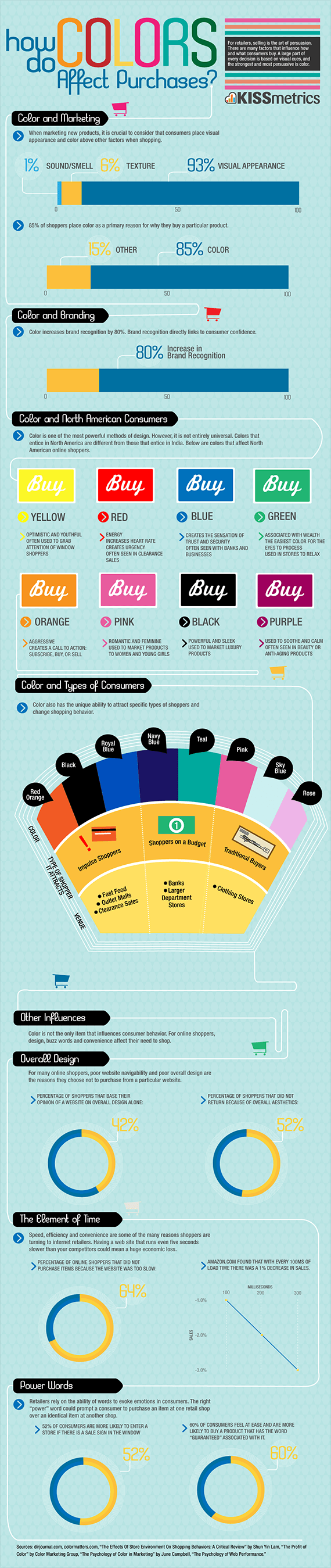
I will try to look at incorporating some of these theories into my visual journal and explore creating work around these ideas,
I will try to look at incorporating some of these theories into my visual journal and explore creating work around these ideas,
OUIL401- Studio Brief 2- Moving around a Space
 I went on to look at how the shop was laid out, to see if there were any visual cues as to where certain customers would move to. I started by looking at shop front and how people would move from the entrance.
I marked out the different potential routed to take and noted the reasons why people would move there. The top image is from the shop front; it is fairly obvious that the left side is mens and the right is womens, mainly from the colour choice of the clothing. However there are other visual cues that encourage the separation. The obvious different sexes of the mannequins is one, and the fact that the mens clothing is hung higher than the womens (for ease of access) is another.
The rail lights direct the eye straight to the back of the store, immediately drawing your attention to it, this is where the key product and arguably the most important stuff happens.
This 'automatic' reaction however obvious it might seem, I found really interesting, and am keen to try and implement them into some of my future work. This will mean looking a lot more at visual composition of an image to create paths and focuses.
I want to start looking at the methods that retailers use to dictate how we move around the store, and how they use subliminal messages to keep us shopping.
OUIL401- Studio Brief 2- Change of Direction
(Excuse the subject pun)
My thoughts are now turning more towards how we interact with spaces and images, I have begun investigating specific cases of how we are influences to move around an area without being told in an obvious way and without knowing about it.
My initial thoughts went towards retail. From working in retail for a few years, I understand that shop floors are designed and manipulated in a way to influence customers to move around the store to best encourage them to use the store to browse properly.
I looked into retail floor plans and how they are arranged to dictate where customers move to maximise browse times. I found an article online which explains basic floor plan layouts and how people usually interact with the spaces. I found this really intriguing and wondered if this movement could be recreated though visual design. (http://fitsmallbusiness.com/planning-your-store-layout/#)
I think my next step will be to explore these layouts and understand how these shapes and paths are used and try to reflect this theory in my own work.


From this idea, I started to create some images which reflected the ideas discovered in my research. Below are the results.


I think now what I need to do is further investigate the actual theory behind how shops are laid out. Maybe looking at some of the specific techniques and ideas they employ.
My thoughts are now turning more towards how we interact with spaces and images, I have begun investigating specific cases of how we are influences to move around an area without being told in an obvious way and without knowing about it.
My initial thoughts went towards retail. From working in retail for a few years, I understand that shop floors are designed and manipulated in a way to influence customers to move around the store to best encourage them to use the store to browse properly.
I looked into retail floor plans and how they are arranged to dictate where customers move to maximise browse times. I found an article online which explains basic floor plan layouts and how people usually interact with the spaces. I found this really intriguing and wondered if this movement could be recreated though visual design. (http://fitsmallbusiness.com/planning-your-store-layout/#)
I think my next step will be to explore these layouts and understand how these shapes and paths are used and try to reflect this theory in my own work.
From this idea, I started to create some images which reflected the ideas discovered in my research. Below are the results.
I think now what I need to do is further investigate the actual theory behind how shops are laid out. Maybe looking at some of the specific techniques and ideas they employ.
OUIL401- Studio Brief 2- Continued
From my investigation into directional arrows, this led me to investigate road signs and other tools which are used to influence how we move. I created some images based off these ideas, experimenting with the colours and wording used in them.


OUIL401- Studio Brief 2- Image Exploration


I'd like to start investigating this in my own visual journal and possibly look at developing my own parodies of road signs and other instructional materials.
OUIL401- Studio Brief 2- Continued
Again focussing on directional arrows, I went on to explore the boundaries of what could be used as a symbol to follow, what it required and what the limits were.
I began by simplifying the shape, only using the triangular tip to dictate direction, then went on to explore different shapes which could potentially used to show direction.


Through this process, I became interested in the subliminal way we are instructed around a space.
I began by simplifying the shape, only using the triangular tip to dictate direction, then went on to explore different shapes which could potentially used to show direction.


Through this process, I became interested in the subliminal way we are instructed around a space.
OUIL401- Studio Brief 2- Continued
Other theories on the initial uses of directional arrows came from bow and arrows. The theory being that it is a humanistic reaction for us to follow arrows. From the early days of hunter-gathering, arrows and spears would have been used to hunt animals and fight; with both only travelling in one direction, It is an automatic reaction for us to follow this.
OUIL401- Studio Brief 2- Simplification of Image
I wanted to look at some visual symbols and how we respond to them. As a small experiment, I took 3 bottles, and simplified the image down to what I thought to be it's simplest form. The bottles all follow the same rough visual aesthetics, with a cap at the top, textured sides and a flat base. But I wanted to know if I could still distinguish what exactly the individual bottles would contain, simply from the rough shape.

OUIL401- Studio Brief 2- Initial Exploration
My initial exploration for the brief was fairly simple. I wanted to look at the most obvious elements which control how we think and what we assume. I started to investigate directional arrows.
Most symbols that we follow are representational of something (examples below)
However, directional arrows are not necessarily representational of a specific element which we assume to follow. I began investigating the origins of the arrows, and the first uses of arrows as a symbol to follow.
The earliest symbol that I came across was in Pompeii in 75AD. Phallic symbols were carved into walls and floors to direct 'customers' as to where a brothel could be found. With the tip pointing towards the direction to follow. I decided to investigate how this may look if it had caught on and been the norm today.


Most symbols that we follow are representational of something (examples below)
However, directional arrows are not necessarily representational of a specific element which we assume to follow. I began investigating the origins of the arrows, and the first uses of arrows as a symbol to follow.
The earliest symbol that I came across was in Pompeii in 75AD. Phallic symbols were carved into walls and floors to direct 'customers' as to where a brothel could be found. With the tip pointing towards the direction to follow. I decided to investigate how this may look if it had caught on and been the norm today.


Studio Brief 2- Proposal
I wanted my visual response work to somewhat link in with my essay work. From my investigation into propaganda through my essay, I was intrigued by how design can influence the way we think, interact, and move. My natural progression of thought from this was to move on to investigate specifically what elements of design can affect our mentality.
I decided that I wanted to look at visual symbols and techniques which are used, and how they are used. After considering what I wanted to look at, I created the following proposal.
'To investigate how visual elements can be used to manipulate the way we think, control what we assume and how we react when looking at them.
Investigating differing types of persuasive techniques and symbols, I will look at the visual applications of these, be it social, instructional or subliminal.'
My thought behind the wording of this proposal was chosen so it could give me freedom to explore as many elements of design as I pleased, but also would give me the opportunity to investigate specific elements and explore them further if I should so choose.
I decided that I wanted to look at visual symbols and techniques which are used, and how they are used. After considering what I wanted to look at, I created the following proposal.
'To investigate how visual elements can be used to manipulate the way we think, control what we assume and how we react when looking at them.
Investigating differing types of persuasive techniques and symbols, I will look at the visual applications of these, be it social, instructional or subliminal.'
My thought behind the wording of this proposal was chosen so it could give me freedom to explore as many elements of design as I pleased, but also would give me the opportunity to investigate specific elements and explore them further if I should so choose.
Friday, 1 April 2016
OUIL401- Studio Brief 2- Initial Proposal
BA (Hons) Illustration - Level 04 Name Matthew Mercer
Module: OUIL401 Context of Practice 1 Date
STUDIO BRIEF 2: Visual Response
The Themes I am going to explore are….
1. Simplified visual cues.
2. Instructional art
3. Art that affects how we think
The theories that will in form my work are…..
1. Where these symbols originated.
2. How visual cues are being used in modern times.
3. The use of symbols as a visual trigger.
The specific subjects that I want to investigate are………
1. How we react to road signs
2. How we see some images as things to automatically follow
3. How we are influenced to move/ do things without directly being told.
In order to visual investigate this content I will……..
1. Research why we respond rapidly to certain colours/symbols
2. Create new images based off the theories I research.
3. Respond visually and informatively to my findings whilst researching.
Subscribe to:
Comments (Atom)